For therapists who trained to HELP people but not to FIND them...
Here's a complete done-for-you system to bring you clients. Automatically.
The Successful Practice Accelerator is the first practice-growing system that combines done-for-you client attraction programs (therapist-created), step-by-step growth roadmap and training, and AI tools designed specifically for psychotherapists. Plus a supportive community of therapists and experts.
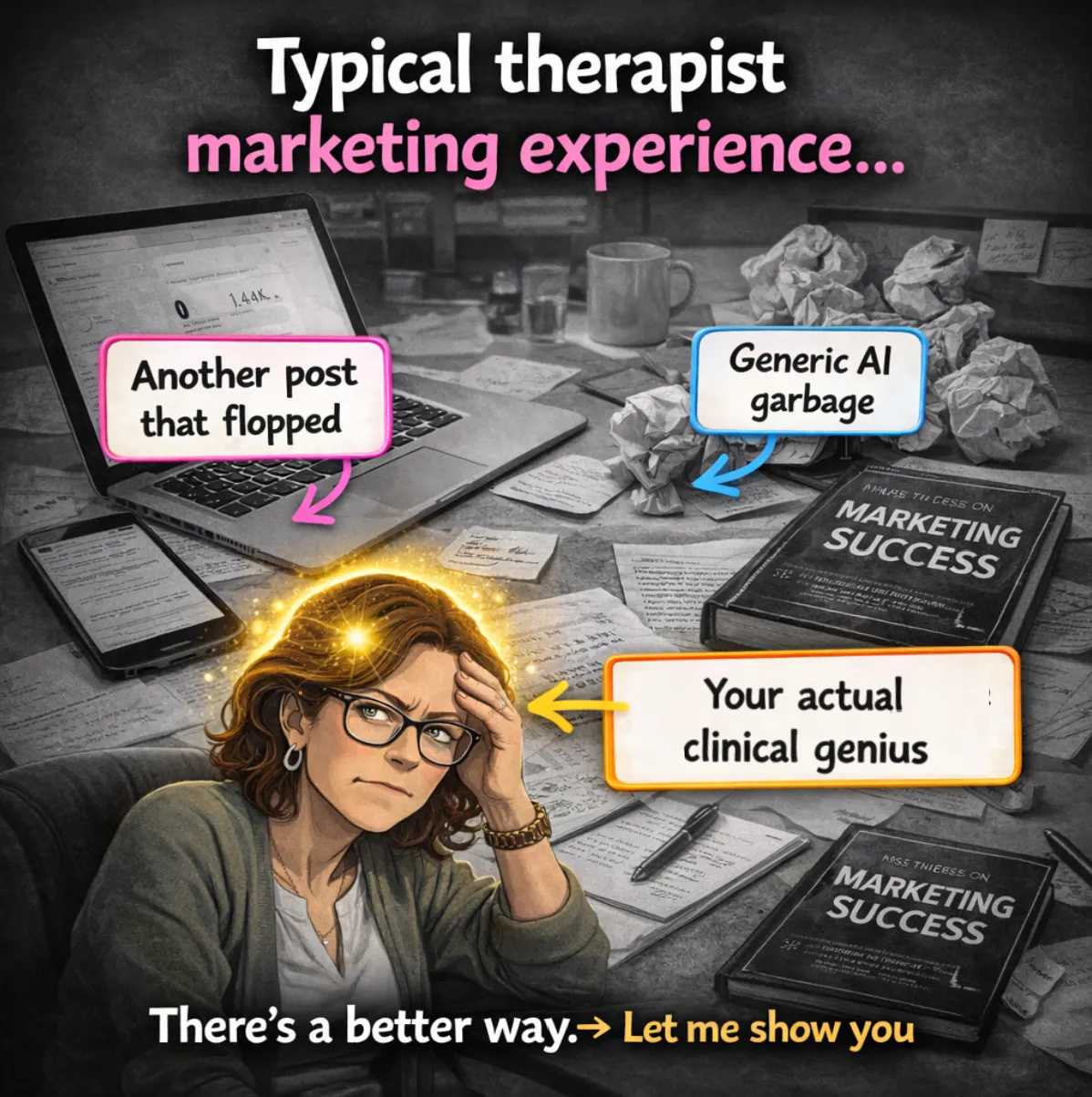
THE STRUGGLE MOST THERAPISTS HAVE
There's a huge gap between being good at therapy and building a practice that works.
You've become genuinely great at helping people — and there are many whose lives have changed because of you.
But growing your practice seems to depend mainly on uncertain referrals, because you haven't found anything else that actually works.
You've tried the generic marketing advice. The "just post consistently" guidance. The business coaching program built for infoproduct marketing and life coaches. None of it accounts for the reality that you're a clinician, not an influencer. You don't transform "limiting mindsets" but deep, psychological patterns.
Your ethics matter. Client safety matters. Clinical precision matters. Your credibility is your currency. Manipulation is never an option.
And you face two BIG problems in getting consistent clients into your practice:
Problem #1: Therapy Speak

WHAT THIS PROBLEM IS:
This isn't a marketing problem.
It's a translation problem.
Most therapists don't fail to grow because they lack skill. They fail because clinical language and client language are two entirely different worlds.
You understand your clients' patterns deeply.
But when you try to communicate that to a potential client on a webpage or social media post, something gets lost. The language that makes perfect sense in a therapy session sounds abstract on a webpage or Facebook post.
Here's an example...drawn from therapist websites...
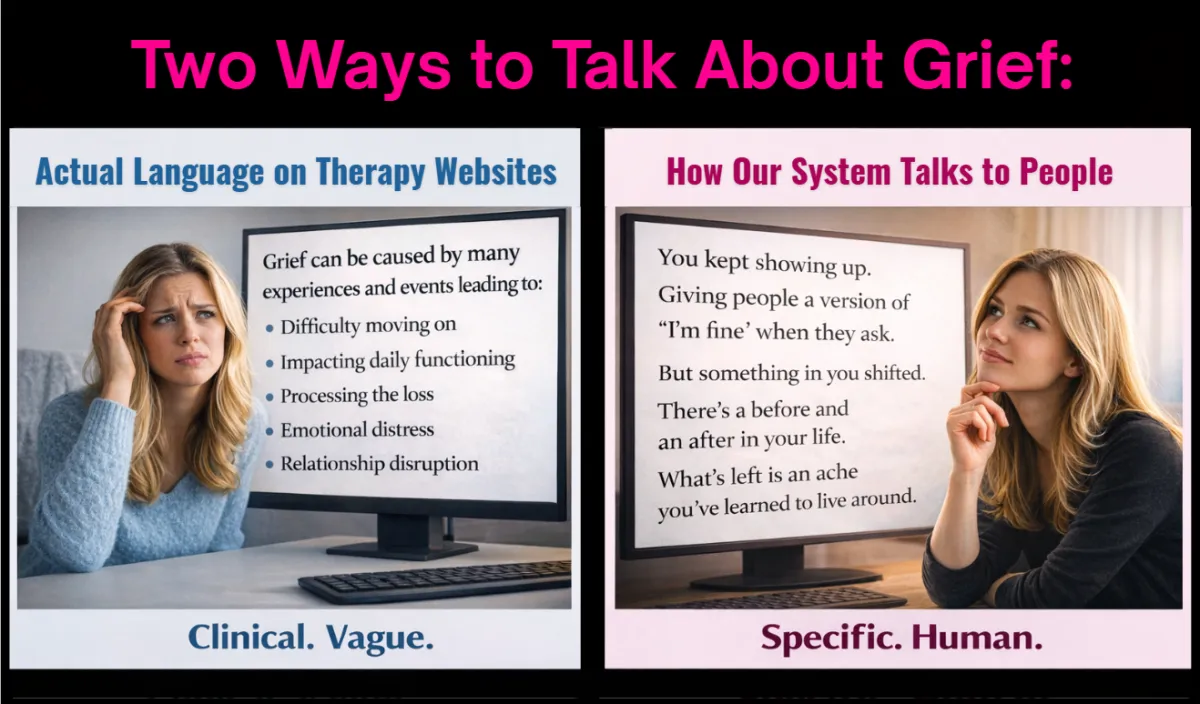
Example: How We Talk to People About Grief

"Trouble moving on" — assumes they know they're stuck. Many don't. They think they're managing.
"Impacting your life and functioning" — clinical framing. They're not thinking in terms of functioning. They're feeling It's too much.
"Process it more effectively" — therapy speak. They have no idea what that really means.
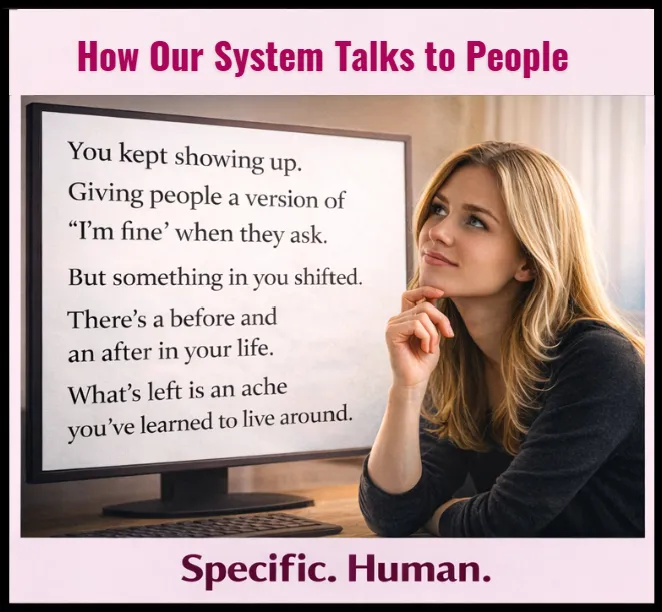
She can recognize her struggle in this text and begin to feel understood by you. She can feel the compassion as well and begin to trust you.
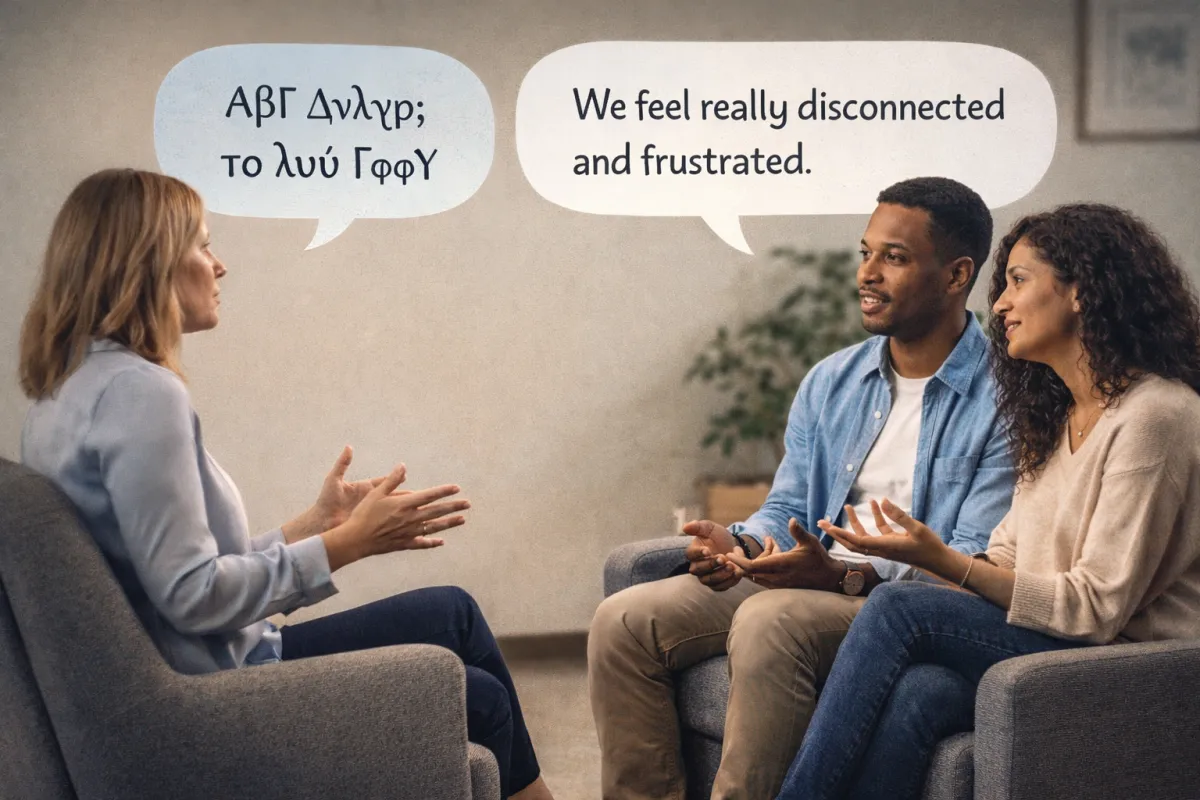
What you need is a Clinical Translation Strategy — one that understands how clients actually think, feel, and cope, what beliefs are blocking them from seeking help, and how to communicate your clinical depth in language that makes them feel finally, genuinely understood.
And then you need a way to get that translated message in front of the right people — without turning you into a full-time content creator. Which leads us to Problem #2...
Problem #2: Not Enough Potential Clients Moving Through Your "Readiness Pipeline"
This IS a marketing problem...but not the way you may think.
It's the lack of an easy-to-implement client attraction system that reaches people at every stage of readiness for therapy.
WHAT THIS PROBLEM IS:
Most therapists don't have a system for attracting clients. Their #1 source of clients is referrals — and they have no system even for that. So they try things.
Post on social media for a while...but they only get a few likes, no clients.
Update their Psychology Today profile...and wonder if it's worth keeping.
Update their webstite...but it's a billboard in a desert no one visits.
Call a couple of potential referral sources...who promise to keep them in mind.
Think of speaking at a conference or church...but never have the time.
Nothing connects to anything else. Nothing compounds. And when life gets busy, it all stops.
So one part of this problem is that you don't have a systematic pipeline for guiding struggling people towards therapy.
The other part of this problem is that there's no pipeline for attracting people towards you at whatever stage of readiness they are in.

When the only thing you offer is "book a consultation," you're proposing marriage on a first date. Most people aren't ready to say yes — not because they don't need you, but because you haven't given them enough to say yes to. You need a "pipeline" that moves them step-by-step towards therapy.
There's a specific order in which practice-building works. Skip the sequence and none of it sticks — not because you're doing it wrong, but because the foundation isn't there yet.
A sequenced system works because it speaks to people at every stage of readiness — so you're building a relationship with people long before they're ready to become clients. By the time they're ready to book, they already know you, trust you, and have been helped by you.
Let me show you what I mean by Stages of Readiness:
I go deeply into the "Stages of .Therapy Readiness" concept, as I call it in my training, but let me give you a sense of it here...

You can't invite someone to consider getting into therapy if they don't first recognize they have a real, solvable problem — not just a personality quirk or a character flaw they're stuck with forever.
Until they reach Stage 2, any invitation to therapy lands as irrelevant. They don't think they have a problem therapy can address. They think this is just who they are.

They believe the problem is real. But they're not yet convinced that therapy is the right answer for a problem exactly like theirs. They may think their situation isn't “serious enough,” or that they should be able to handle it on their own.
You can't invite them to book a consultation with you until they first agree that therapy genuinely helps with problems exactly like theirs. That agreement has to come first.
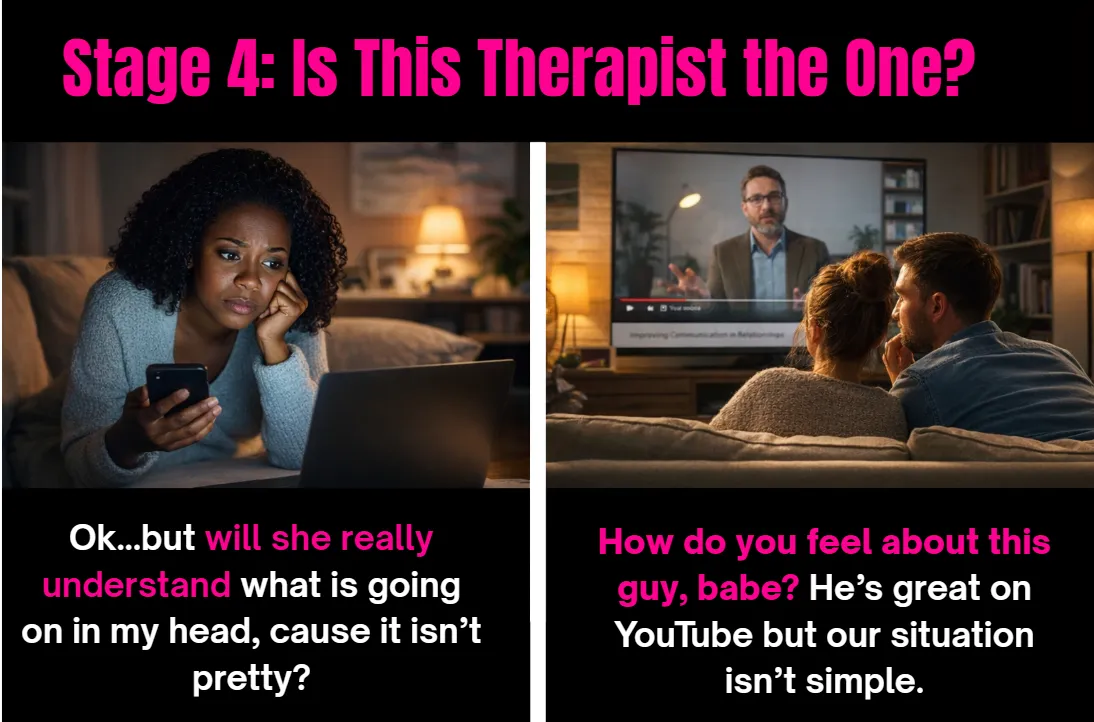
They're ready for therapy — but they're still choosing. They won't schedule a session with you until they've come to trust that you are the right therapist for them: through a trusted referral, through what they discover about you online, or through a workshop or webinar where they experienced your approach firsthand.
Trust at this stage isn't built in the consultation. It's built before they ever reach out.
INTRODUCING A SYSTEM THAT MOVES PEOPLE THROUGH THESE STAGES OF READINESS. AND IT'S ALREADY DONE FOR YOU...
The Successful Practice Accelerator
A complete practice-building system designed from the ground up for clinicians by a clinician. Combines clinical translation, proven growth resources, and AI tools built with clinical precision and therapeutic ethics.
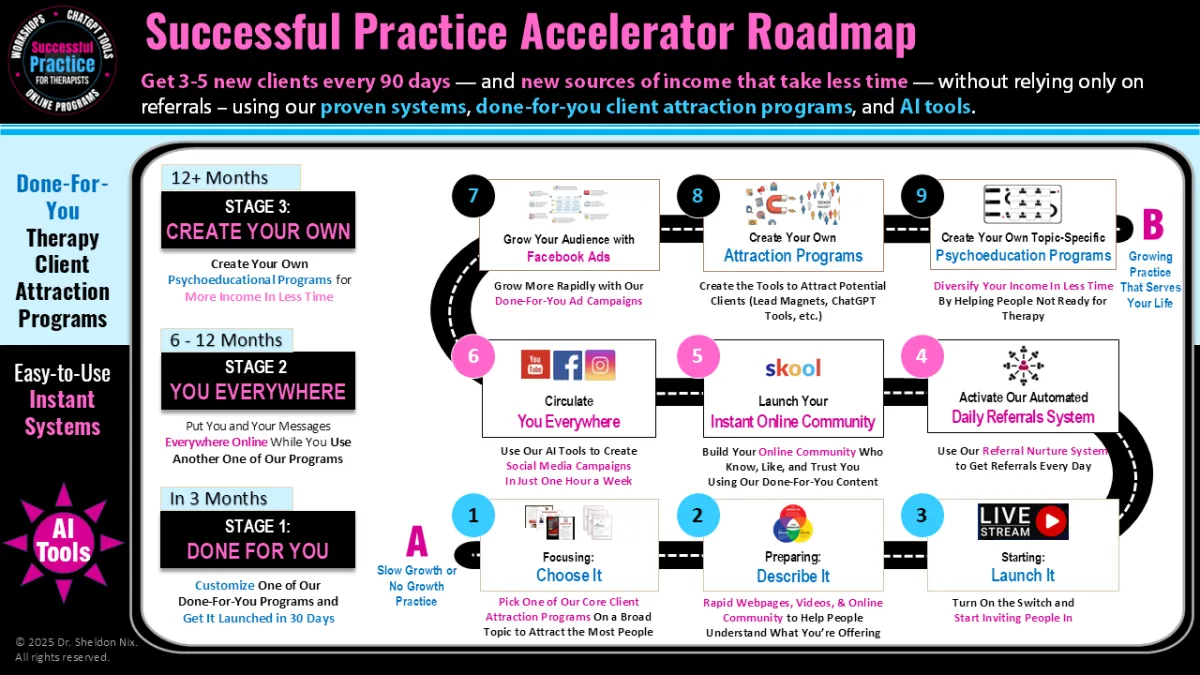
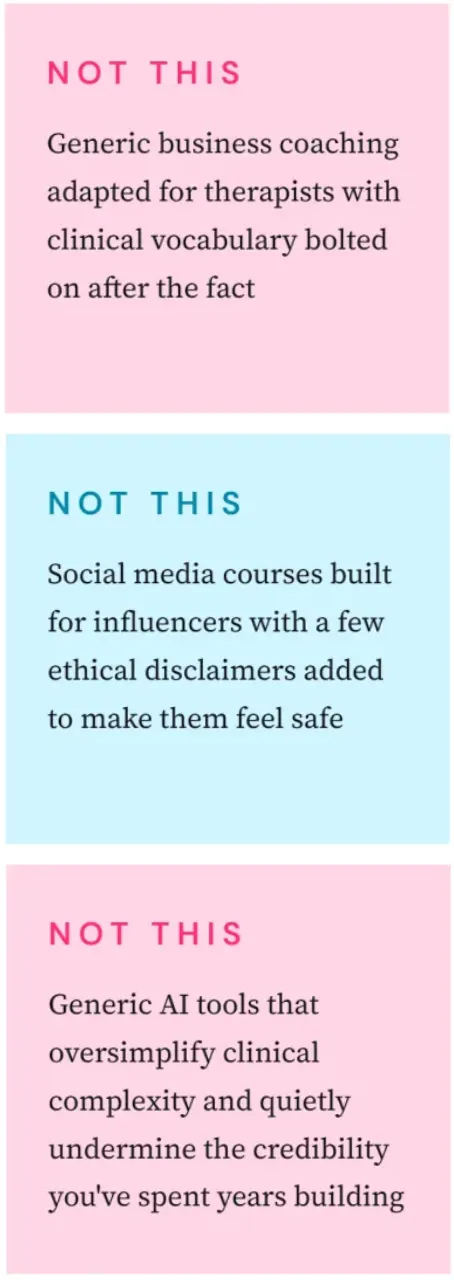
What This Is Not...
What This Is Not
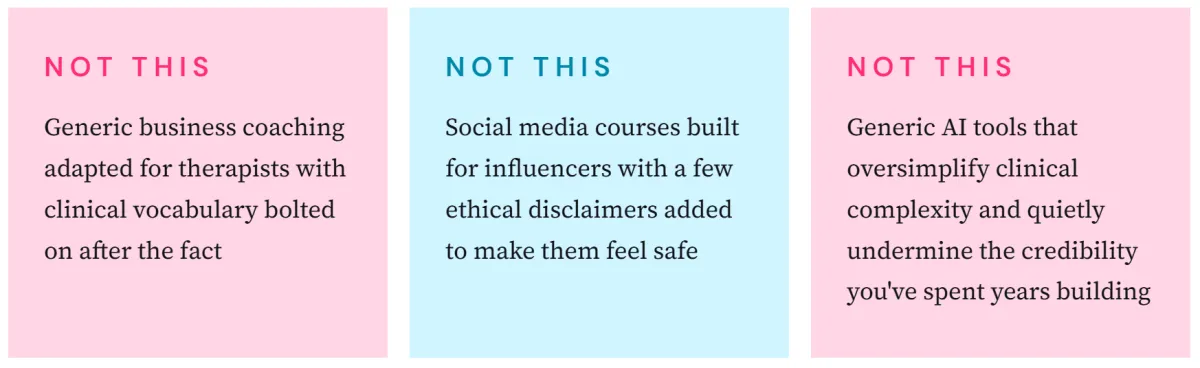
Three stages. Nine steps.
A complete practice-building system.
Three stages.
Nine steps.
A complete practice-building system.
Most practice-building advice suggests time-consuming strategies, approaches developed for life coaches, course creators, influencers, or other businesses.
And there are a number of organizations that will build you a therapy website for you (using clinical rather than human language). Some will even advertise for you, which is actually a good thing. But then you are left to do all the rest of the things needed to bring clients in.
The Successful Practice Accelerator has a sequence of done-for-you resources that put struggling people into a community surrounding you, getting to know you, and moving them towards therapy with you.
Each stage builds on the last. You don't skip ahead. You install each layer in order, and the systems compound to grow the number of people who know about you, like you, and trust you.
The three stages are designed for where therapists actually are: overwhelmed by options, short on time, and uncertain where to start.
The goal of Stage 1 is simple: get something real in the world, fast. Not a polished multi-module course. Not a complete marketing infrastructure. One client attraction program — chosen from proven templates, customized to your clinical voice, and launched.
Done-for-you means exactly that. The curriculum structure, the content framework, the messaging — it's already built. Your job is to make it yours and turn it on.
Stage 2 is about reach without grind. Once you have a program running, the next job is consistent visibility. Not a content treadmill. Automated systems that circulate your message, build your audience, and generate referrals — with minimal ongoing time investment.
The AI tools do the translation heavy lifting. You provide the clinical insight once. The system produces the content.
Stage 3 is where your clinical expertise becomes a scalable asset. By this point you have a running practice, an automated visibility system, and a growing community. Now you build what only you can build: original programs grounded in your specific approach and population.
This is also where the income diversifies. Psychoeducational programs and workshops reach people who aren't ready for individual therapy — and generate income that doesn't require your direct time for every dollar earned.
3 Ways to Take the Next Step
See the complete Successful Practice Accelerator system in action. In 90 minutes, you'll understand exactly how the Clinical Translation Engine works, what stage-matched content looks like in practice, and how our done-for-you resources start sending potential clients your way.
- The translation problem — and the specific mechanism that solves it
- A live walkthrough of the three-stage roadmap
- Stage-matched content demonstrations using real examples
- How the AI tools work in a clinical context
- A clear picture of what joining looks like at each tier
Experience the Successful Practice Accelerator strategy with an introductory program similar to what you will do with potential clients. Learn the strategy, get a feel for the client attraction resources, and the AI tools firsthand — and discover if this is the right fit for you.
- Discover the strategy with Dr. Nix's video training
- Get an actual client attraction program so you can "look under the hood" (training on how to use it but no coaching included, though!)
- Hands-on experience with a couple of the AI translation tools
- Twice-a-month live Q&A group sessions with Dr. Nix to get your questions answered
You've seen enough. You know this is the right system and you're ready to install it. Choose Standard for full access to the core infrastructure, or Premium for additional done-for-you support and direct access to Dr. Nix.
- Complete done-for-you program library
- Full AI tool suite — all 11+ clinical GPTs
- Three-stage roadmap with implementation support
- Community access and monthly group calls
- Premium: additional done-for-you support and direct access
This is a Paragraph Font